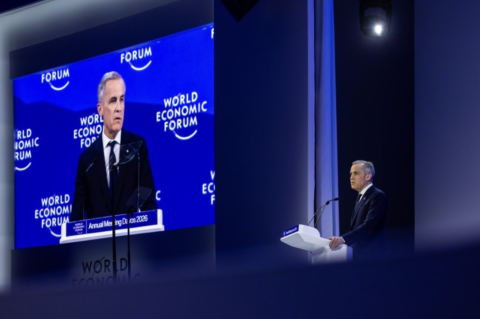
Speaking yesterday at the World Economic Forum in Davos, Prime Minister Mark Carney declared that the so-called “rules-based international order” is over. He warned that middle powers face a world defined by coercion rather than cooperation, urged renewed commitment to territorial integrity and sovereignty, and called for greater unity among countries caught between resurgent great-power rivalry.
Carney is right that the old order is not coming back. He is right that sovereignty matters, and that Canada and its partners cannot rely on geography or historic alliances to guarantee security or prosperity. But where his remarks fall short is in their insistence on answering the crises of our time through the lens of neoliberalism—an ideology that has, for decades, hollowed out the very sovereignty he now claims to defend.
In other words, Carney diagnoses a rupture in the global order while leaving intact the economic framework that helped produce it. Neoliberalism is not guided by sovereign states exercising democratic control, but by the steady transfer of power to non-state actors: multinational corporations and the ultra-wealthy. This is the critical point at which Carney’s Davos speech diverges from a comprehensive view of reality.
His intervention, then, is better understood as a critique of liberal international relations—the belief that norms, institutions, and shared rules can restrain hard power—than as a break with neoliberal political economy. He names the collapse of multilateral restraint, but leaves largely untouched the economic order that concentrated power in corporate hands long before today’s geopolitical rupture.
Sovereignty is not an abstraction and it cannot be exercised through rhetoric alone. Public ownership, regulatory power, tax sovereignty, and democratic control over investment are real tools that protect a nation’s sovereignty. When these tools are surrendered to foreign capital and multinational corporations, we begin to operate under an illusory or symbolic form of sovereignty, rather than real democratic sovereignty.
Even if neoliberalism as a coherent global project is now fracturing, its material legacy remains firmly intact. Capitalism, exploitation, and corporate power have not receded. What has collapsed is the ideological cover that once framed markets and institutions as neutral, stabilizing forces rather than engines of inequality and domination.
That divergence explains why his remarks focused on trade diversification and re-militarizationas the fundamental solutions to American aggression. But the United States has gone far beyond imposing tariffs on middle powers. It has funded a genocide in Gaza, invaded Venezuela and abducted its president, repeatedly threatened to invade Greenland, and even turned its violent attention inward, terrorizing migrant communities and its own citizens.
At every step, US-based corporations have been complicit, building the tools and infrastructure of violence and then profiting from their use. Along the way, decades of government policy that under-taxed and under-regulated corporations and the wealthy have enabled these outcomes. Carney’s speech leaves this out, focusing instead on responding to a “new world order” created by American divergence, while ignoring the corporate interests that helped drive America’s descent into fascism and extreme wealth concentration.
As Carney himself put it, “We are no longer relying on the strength of our values, but the value of our strength.”
To re-establish power, to defend sovereignty, and to strengthen democratic values, Canada and its allies must do more than challenge the American state. We must also confront the influence of US corporate power, the ultra-wealthy, and the ideology that continues to serve their interests.
In that world, it becomes possible not only to value our strength, but to strengthen our values. In that world, we recognize that our population is among the most educated and talented in the world precisely because of public investment in education. We recognize that being resource-rich or an energy superpower means little if much of our energy sector is owned by American shareholders. We recognize that militarization, too, primarily serves American-owned defence firms. And we recognize that Canadian sovereignty requires more than diversified trade.
It requires diversifying investment. Away from dying commodities like oil and gas and toward sustainable alternatives and renewables. It requires investing in a universal public health care system that remains among the best in the world. It requires diversifying ownership of both real and intellectual property.
We must also recognize Canada’s own role in weakening international human rights, accelerating planetary destruction through fossil fuel investment, and ceding democratic power to the interests of the few by allowing extreme wealth and influence to accumulate unchecked.
The danger is not that neoliberalism is ending, but that it is being replaced by something harsher: a world of militarized competition, fascism, and technocratic management of permanent crisis. Acknowledging the collapse of the old order is not the same as building a democratic alternative to it.
By redistributing power domestically and choosing to invest in what makes us distinct, we can build a Canada worth defending, not only for ourselves, but for our children and grandchildren.
Muneeb Javaid is the development coordinator at Canadians for Tax Fairness, a non-profit, non-partisan organization that advocates for fair and progressive tax policies, aimed at building a strong and sustainable economy, reducing inequalities, and funding quality public services.
This article originally appeared in Canadian Dimension.
