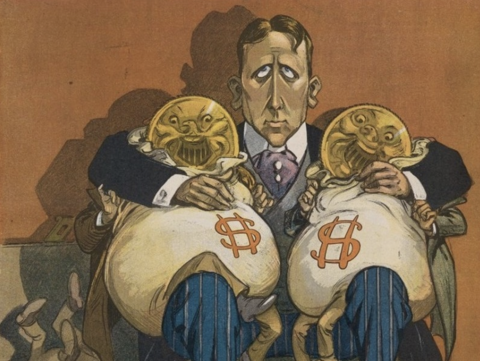
It’s déjà vu all over again. We’re into a new year, and once again, Statistics Canada data shows that corporate profits hit a record $677 billion in 2025. This new peak exceeds even the levels reached during the rampant profiteering and price gouging we saw during the pandemic. Much of this growth came from the financial sector, which recorded over $200 billion in annual profits for the first time.
Although profits naturally rise over time with inflation, last year’s record can’t be explained by inflation alone. Instead, the corporate profit rate—the share of revenue left after covering operating costs—has been steadily climbing. In 2025, it reached 10.7 percent, the third highest in the past 30 years, after 2021 and 2022.
Over the past two decades, the corporate profit rate has grown steadily. In the 2000s, it averaged around six percent, rising to roughly eight percent in the 2010s. Since 2021, however, it has jumped into double digits and hasn’t fallen below 10 percent.
During the pandemic and the years that followed, large corporations leveraged their market power, supply chain disruptions, and public expectations of inflation to permanently boost their profit margins. With those changes now entrenched, the biggest, most profitable companies in Canada and worldwide have established a new norm: capturing a larger share of the prices we pay for nearly everything.
If you took Econ 101 and have been living under a rock for the past few decades, you might dust off your old textbook and ask, “Don’t profitable companies use their earnings to invest in communities, hire more people, support the government, and fund vital public services?”
Unfortunately, the answer to that question has increasingly become: not really.
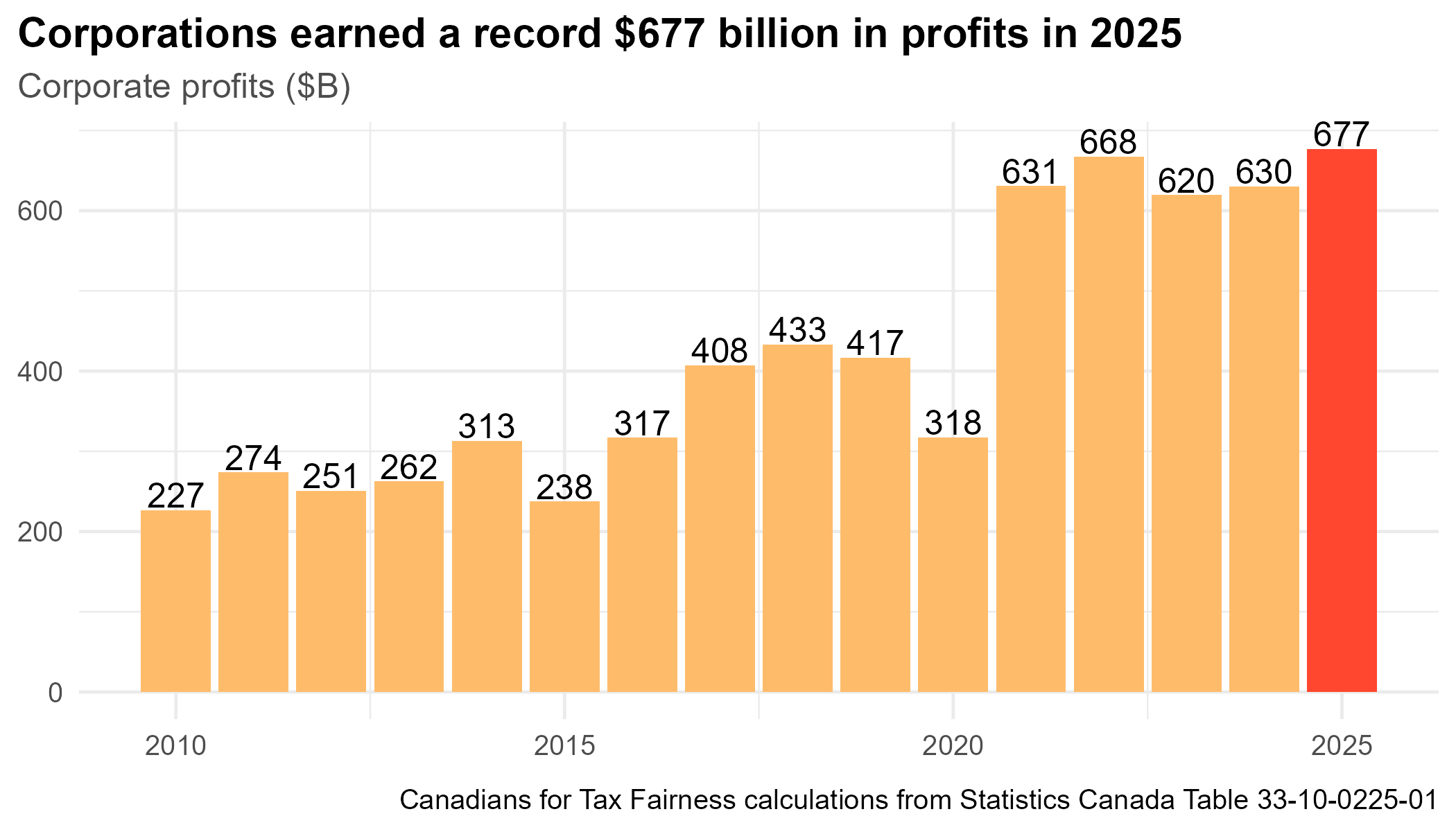
Canadians for Tax Fairness calculations from Statistics Canada Table 33-10-0225-01
Profits soar, taxes plunge
The share of profits that corporations pay in taxes has never been lower, thanks to decades of steady cuts to both federal and provincial corporate tax rates. In the 1990s, the effective corporate tax rate hovered around 39 percent. By the 2000s, it had fallen to roughly 29.5 percent, dropping further to 20.6 percent in the 2010s. As of last year, the average effective rate was just 18.3 percent.
On top of that, successive federal governments have expanded corporate tax exemptions—like accelerated capital cost allowances and the partial inclusion of capital gains—which are projected to cost over $22 billion in 2025 alone. Combined, these cuts and exemptions have cost Canada $1.1 trillion in desperately needed revenue over the past two decades.
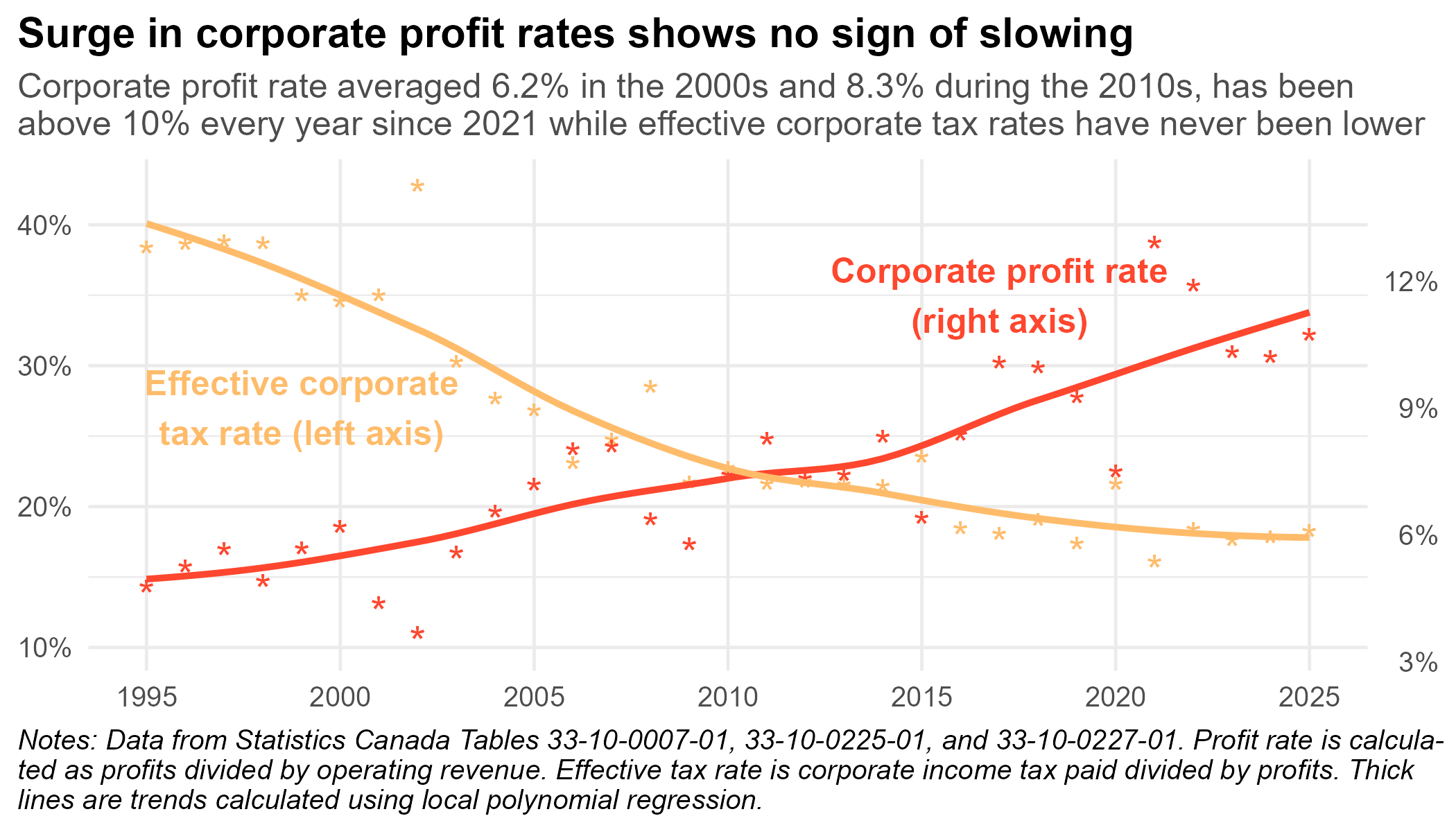
Surge in corporate profit rates shows no sign of slowing
Despite record profits and rock-bottom corporate tax rates, corporations are still not investing in Canada. Prime Minister Mark Carney spent his first year in office promoting one investment deal after another, calling his first budget a “generational investment strategy.” The budget even introduced a “Productivity Super-Deduction,” described as a “set of enhanced tax incentives” meant to “make it easier for businesses to invest and grow.”
While corporations may indeed find these deductions “super,” the investments they’ve generated are far from it. After nine months under a Carney government in 2025, non-financial corporations invested less than they did in 2024—$212 billion in investments compared to $473 billion in profits. That’s less than what they invested each year from 2011 to 2014, when profits were less than half of 2025 levels. Put simply, the evidence is clear: corporate tax cuts and sky-high profits do not guarantee higher investment.
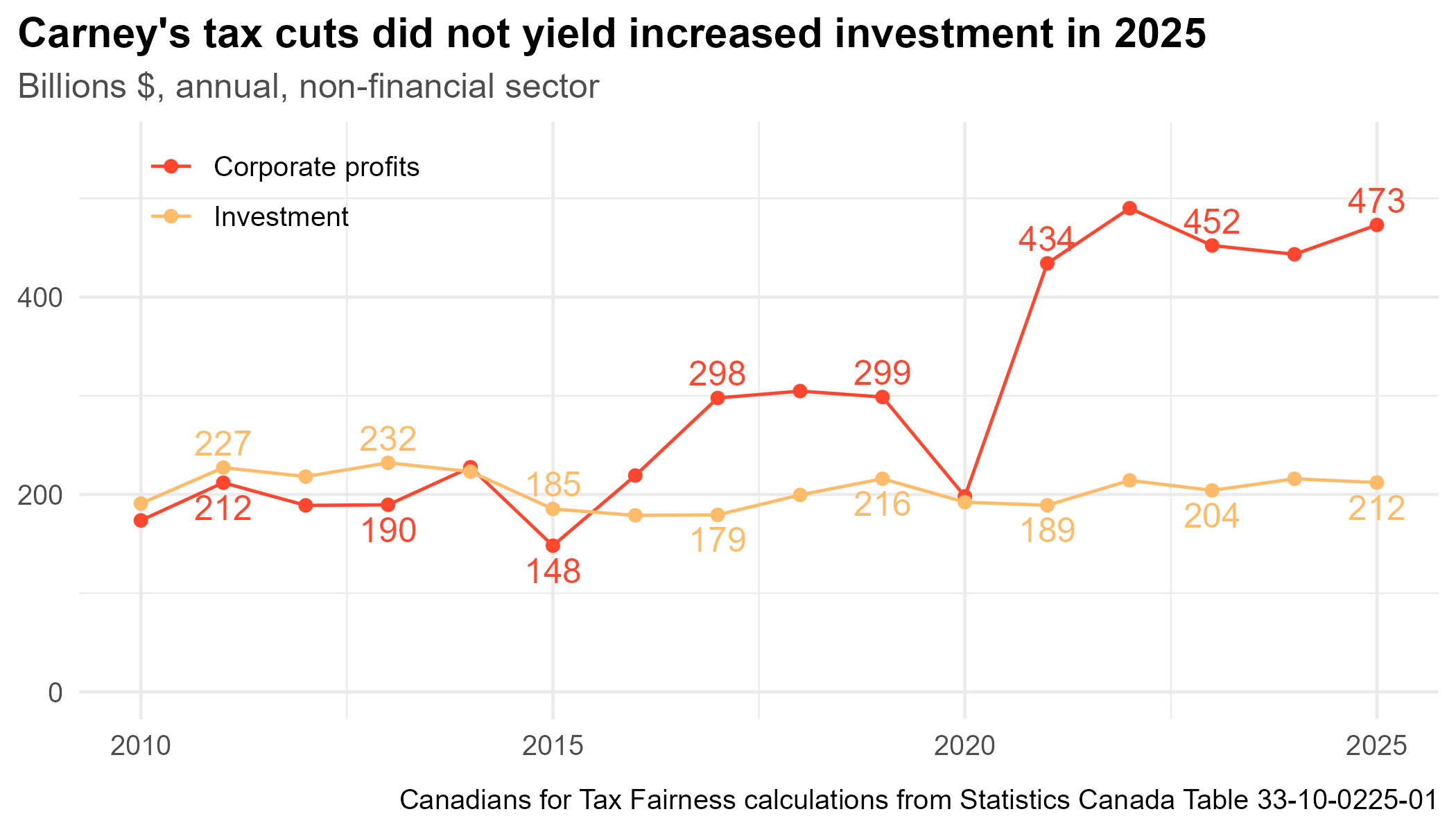
Carney's tax cuts did not yield increased investment in 2025
Rethinking the rules
With oil prices spiking due to the US and Israel’s war in Iran, corporate profits are likely to climb even further in the first quarter of 2026. The last period of fossil fuel inflation—from 2022 to 2024—cost the average Canadian household $12,000. But as economist Jim Stanford has noted, higher prices at the pump in Canada are a policy choice, not an unavoidable market outcome. Just as corporations choose the prices they charge, we have choices about the policies we implement.
One place to start is a permanent excess profits tax that can be triggered during crises like the war in Iran, preventing crisis profiteering—a measure recently called for by the Alberta Federation of Labour. Following the example of countries like the United Kingdom, which implemented a pandemic windfall profits tax set to run until 2030, Canada could collect billions from price-gouging oil and gas companies to help offset higher costs for consumers.
We should also end subsidies for the fossil fuel industry, which is highly profitable, ecologically damaging, and poses a growing threat to Canadian sovereignty.
It’s also long past time for a real industrial policy. This could involve using Crown corporations to compete with private companies in essential sectors, keeping profit margins in check, and strategically deploying pension funds to invest in Canada—currently, only 13 percent of Canada Pension Plan assets are invested domestically.
The status quo is unsustainable. For decades, governments have tried to spur corporate investment by lowering taxes. Time and again, this approach has failed. Corporate profits and power are at record highs, while Canadians already struggling with the cost-of-living crisis continue to face relentless price increases.
To rein in corporate power and make life affordable, we can’t rely on the same neoliberal toolbox. Strong, democratic nations are built by investing in people and communities—not funnelling more money and influence to a few corporations. It’s time for a new approach that works for everyone.
Jared A. Walker is the Executive Director of Canadians for Tax Fairness, a non-profit, non-partisan research and advocacy group fighting for fair, progressive taxation.
Silas Xuereb is an Economist and Policy Analyst with Canadians for Tax Fairness, and co-author of “The new robber barons: A quarter century of wealth concentration in Canada.”
This article originally appeared in Canadian Dimension.
